
Why Karty?
I started Karty to make the engine and framework I wanted to use myself: write game rules in Go, build a room from simple shapes, and try it quickly.
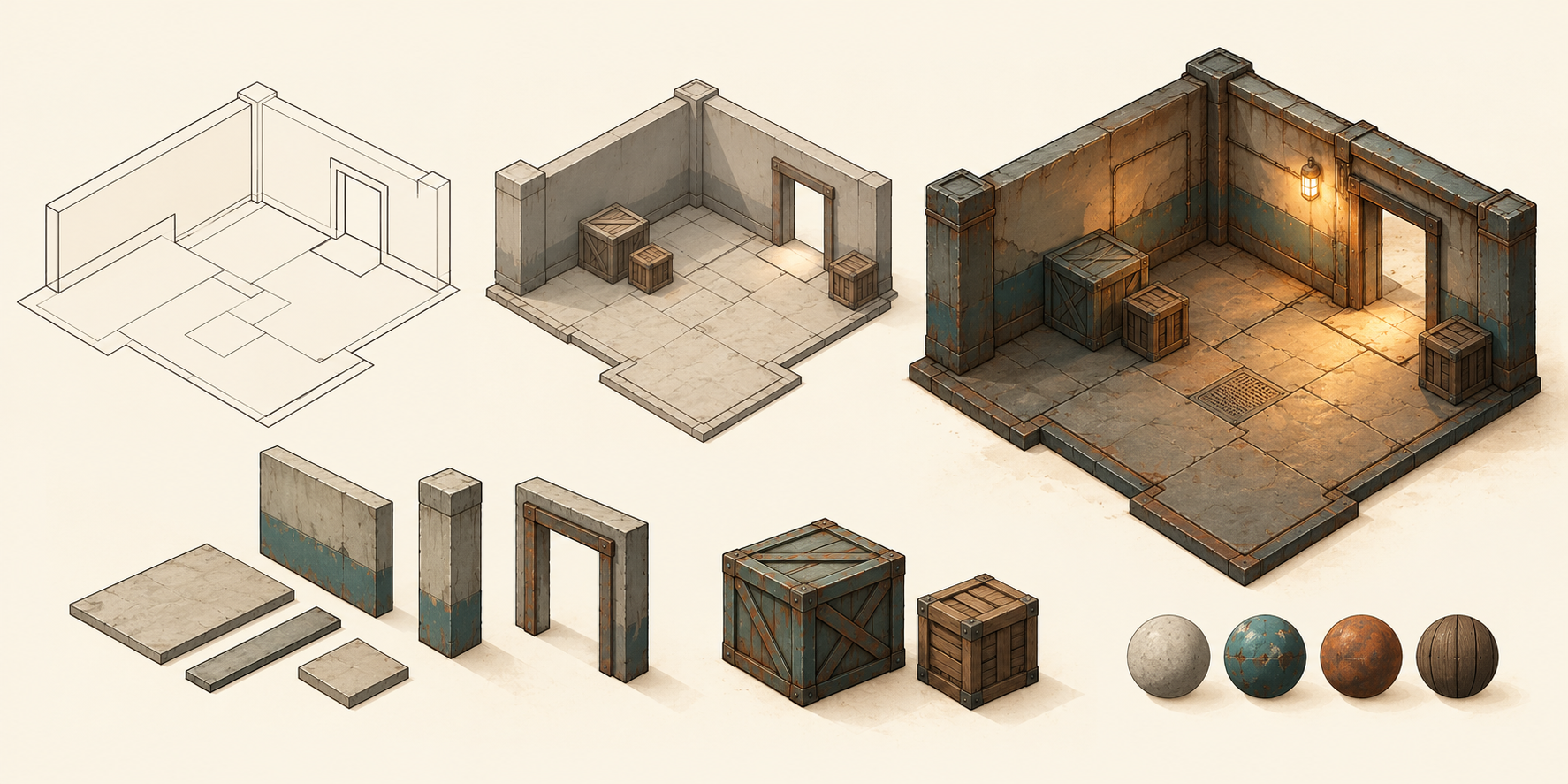
Make a room and try it
Unity and Unreal feel too big, too slow, and too general-purpose for my games. I miss the directness of Doom and Half-Life level editors. Making a room and trying it felt simple.
Karty is aimed at small games and prototypes, including retro first-person games, isometric adventures and 2D games. For worlds, I want to work with floor plans, heights, materials and reusable objects. That should be enough to make a space worth exploring without first learning a full 3D modeling tool.
Development
- See changes immediately.
karty devwatches your level files and updates
the preview as you work.
- Iterate quickly. Target code recompilation in 2–3 seconds.
Visual
- Good lighting. Bake bounced light with Karty's built-in light baker,
without extra tools.
- Give the scene personality. Use built-in post-processing effects for
atmosphere, storytelling and gameplay highlights.
- Fire, smoke and more. A flexible GPU particle system draws thousands of
sprites.
Performance
- Run on modest hardware. Target 720p at 60 FPS in WebGL on a five-year-old
smartphone.
- Start playing your game quickly. Keep downloads small and aim for startup within
a few seconds.
- Play offline. Prefetch and cache assets in the background, ready to play
without internet once the download is complete.
Assets
- Skip image preparation. Let the asset pipeline
resize textures, pack atlases and handle compression.
- One texture is enough. Generate normal, height and ambient occlusion maps
from a single albedo image.
- Build large maps. Automatic chunking and background streaming let your
world grow.
Flexibility
- UI with less code. KartUI provides a dedicated language and reusable
components for game interfaces.
- Bring other tools. Packages let the community share
reusable integrations, code and components.
Continue with Architecture, or make your first game.